Can You Make Money on TikTok in Canada?

Updated: Sep 28

Yes, Canadians can make money on TikTok, but the options are different from what most American creators talk about online.
TikTok hasn't added Canada to its Creator Rewards Program, and TikTok Shop hasn't launched here. That removes the two revenue streams you hear about most.
What's left still works: brand sponsorships, affiliate commissions, UGC, LIVE Gifts, Effect Creator Rewards, and selling your own products or services. For most Canadian creators, TikTok is where people find you. The money comes from brands, customers and commissions.
You also don't need a huge following. 10,000 followers who are Canadian homeowners, runners or gamers can be worth more to the right business than a much bigger audience spread across the world.
If you're still at the audience-building stage, our guide to becoming a micro-influencer on TikTok in Canada goes deeper into choosing a niche, building engagement and becoming attractive to brands.
TikTok Monetization Options in Canada at a Glance
Method | Available in Canada? | Who pays you | Typical requirement |
Creator Rewards Program | No | TikTok | Eligible country, 10K followers, 100K views in 30 days |
TikTok Shop | No | Customers through TikTok | Supported Shop market |
Brand sponsorships | Yes | The brand | No fixed minimum |
TikTok One / Creator Marketplace | Yes, for eligible accounts | The brand | 10K followers plus activity requirements |
LIVE Gifts | Yes, for eligible accounts | Viewers, through TikTok | 18+ and 1,000 followers to go LIVE |
Effect Creator Rewards | Yes | TikTok | Effect House badge requirements |
Affiliate marketing | Yes | The merchant or network | Depends on the program |
UGC | Yes | The brand | No follower minimum |
Your own products or services | Yes | Your customers | No follower minimum |
Most creators who earn well combine two to four of these.
Does TikTok Pay Creators in Canada?
There are several ways TikTok can contribute to a Canadian creator's income, but it helps to separate direct TikTok payments from revenue generated using your TikTok audience.
For example, imagine two Canadian creators who each generate one million views during a month.
Creator A receives those views but has no sponsorships, affiliate links, products or monetization features available. The views themselves do not automatically produce a cheque from TikTok.
Creator B uses the same attention to land a $750 sponsorship, generate $400 in affiliate commissions and send customers to a $30 digital product. That creator has monetized TikTok even though TikTok did not directly pay them for those one million regular video views.
That distinction explains why Canadian creators should build a monetization system, rather than concentrating exclusively on views.
Is the TikTok Creator Rewards Program Available in Canada?
As of September 2026, TikTok has not announced Canada as an eligible market for its standard Creator Rewards Program.
This program replaced TikTok's older Creator Fund and Creativity Program Beta. TikTok's official 2025 announcement expanding Creator Rewards into Mexico listed the United States, United Kingdom, Germany, Japan, South Korea, France and Brazil as existing participating countries. Canada was not included.
TikTok has continued to describe Creator Rewards as a program available only in eligible regions, so Canadian creators should not build an income forecast assuming they will receive regular Creator Rewards payments for their video views.
You can read TikTok's own explanation of the differences between Creator Rewards and the former Creator Fund.
What Are the Creator Rewards Requirements?
This is still worth understanding because many earning screenshots and TikTok monetization discussions online come from creators in eligible countries.
The standard requirements associated with Creator Rewards include being at least 18, having a Personal Account in good standing, being located in an eligible region, having at least 10,000 followers and generating at least 100,000 video views during the previous 30 days.
Eligible videos also generally need to be original, high-quality videos longer than one minute. TikTok specifically excludes certain content, such as Duets, Stitches and sponsored videos, from its definition of original content for Creator Rewards.
For a Canadian creator, these numbers are useful as context, but reaching 10,000 followers and 100,000 monthly views does not by itself unlock Creator Rewards while Canada remains outside the eligible markets.
Is the Old TikTok Creator Fund Available in Canada?
No. More importantly, creators should stop looking for ways to join it.
The original TikTok Creator Fund has been discontinued and replaced by Creator Rewards. Older Canadian articles and videos still discussing the Creator Fund or "Creativity Program Beta" are therefore outdated.
This matters because searching for "TikTok Creator Fund Canada" can create the impression that Canadian creators simply need to reach a follower threshold before applying. That is not how the current system works.
The practical question in 2026 is no longer "How do I join the Creator Fund in Canada?" It is "Which TikTok monetization methods are actually available to me in Canada?"
Is TikTok Shop Available in Canada?
TikTok Shop is still not officially available in Canada as of September 2026.
TikTok Shop creates a native shopping experience where users can discover a product in a video or LIVE stream and complete their purchase within TikTok. Creators in supported countries can also participate in TikTok Shop's affiliate ecosystem and earn commissions by promoting products sold through the platform.
TikTok's current Shop documentation, updated in June 2026, lists markets including the United States, United Kingdom, Mexico, Brazil, France, Italy, Spain, Japan and several Southeast Asian markets. Canada is not included. You can check TikTok's current list of countries where TikTok Shop is officially available.
For Canadians, this changes where the transaction happens, not whether TikTok can generate sales.
A Canadian clothing company, for example, could post a 25-second video demonstrating a new jacket, receive 80,000 views and direct interested viewers to its own Shopify or Wix store. TikTok created the discovery; the website completed the transaction.
That is a different model from TikTok Shop, but it can still be profitable.
What Should Canadian Sellers Use Instead of TikTok Shop?
Canadian creators and businesses should treat TikTok primarily as the top of the sales funnel.
A practical setup might look like this:
TikTok video → profile or website link → product/service page → checkout
For example, a Canadian fitness creator could demonstrate resistance bands in a short workout video and direct interested viewers to an affiliate page. A candle company could show the production process and link viewers to its online store. A consultant could answer a common industry question and send viewers to a service page or consultation form.
The goal is not simply to accumulate views. It is to give viewers a logical next step once the video has created interest.
Creators interested in the commission-based model can also read our complete guide to affiliate marketing in Canada.
Which TikTok Monetization Methods Actually Work in Canada?
The options are easier to understand when they are separated by who ultimately pays you.
Monetization method | Available to Canadians? | Who pays you? | Typical requirement |
Creator Rewards Program | Not currently announced for Canada | TikTok | Eligible country + program requirements |
TikTok Shop | Not currently available in Canada | Customer/TikTok ecosystem | Supported Shop market |
Brand sponsorships | Yes | Brand | No universal follower minimum |
TikTok One / Creator Marketplace | Available to eligible accounts | Brand | Generally 10,000+ followers plus activity requirements |
LIVE Gifts | Available to eligible accounts/regions | TikTok ecosystem/viewers | Generally 18+ and 1,000 followers to go LIVE |
Effect Creator Rewards | Yes | TikTok | Effect House eligibility requirements |
Affiliate marketing | Yes | Merchant/affiliate network | Depends on the program |
Your own products or services | Yes | Customer | No TikTok follower minimum |
YouTube or other platform revenue | Yes | Other platform | Depends on that platform |
This is why a diversified approach usually makes more sense than waiting for one TikTok feature to become available in Canada.
A creator could eventually earn from three or four sources at the same time: a sponsored video, affiliate commissions from older product reviews, LIVE Gifts and customers who discover the creator's own service through TikTok.
A TikTok Program Canadians Often Overlook: Effect Creator Rewards
There is one important exception to the idea that TikTok does not directly reward Canadian creators: Effect Creator Rewards is available in Canada.
The program is aimed at creators who build TikTok effects using Effect House rather than creators simply publishing regular videos. TikTok currently lists Canada among the eligible countries.
This is a more specialized opportunity, but the numbers are worth knowing.
Effect Creator Rewards Eligibility
TikTok currently requires an Effect House creator to be at least 18 and located in an eligible country such as Canada. The creator must also reach Gold, Platinum or Diamond Badge status.
For Gold status, that means:
publishing at least 5 effects
having at least 3 effects used in 1,000 qualified videos each
completing the required tax and payment setup
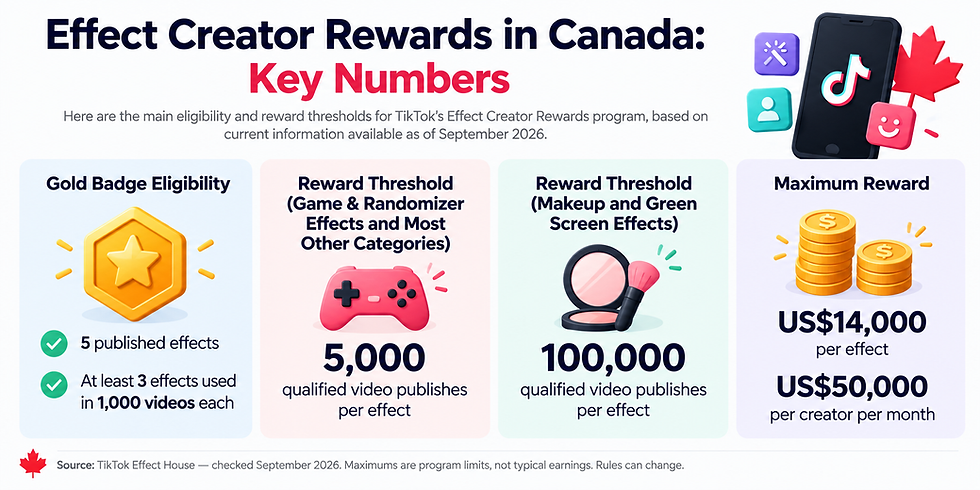
The threshold for an individual effect to begin generating rewards depends on the type of effect. TikTok currently lists 5,000 qualified video publishes for game, randomizer and many other effect categories, while makeup and green-screen effects have higher thresholds.
TikTok also states that one eligible effect can earn a maximum of US$14,000, while one creator can earn a maximum of US$50,000 per month through the program. Those are maximum program limits, not typical earnings.
Creators interested in this route should review TikTok's current Effect Creator Rewards eligibility and payout rules before investing significant time into building effects, because requirements and participating markets can change.
For most Canadian TikTok creators, Effect Rewards will remain a niche opportunity. Brand partnerships, affiliate sales and selling your own products are likely to be much more relevant.
Brand Sponsorships and Paid Collaborations

Brand sponsorships are one of the most accessible monetization routes because they do not depend on Canada being admitted to the Creator Rewards Program or TikTok Shop.
A business is paying for access to your audience, your ability to create content, or both. This means follower count matters, but it is only one part of the value of a sponsorship.
A Toronto food creator with 12,000 followers whose audience is concentrated in the GTA may be attractive to a restaurant opening a new Toronto location. A Canadian running creator might be attractive to a shoe retailer or race organizer. A creator producing bookkeeping content for Canadian entrepreneurs could have an even smaller audience but influence customers buying relatively expensive services.
The commercial value comes from audience fit and purchasing influence, not simply from having a large number beside your profile picture.
How TikTok Sponsorships Usually Work
Brand collaborations can take several forms.
A brand might send a free product and ask the creator to test it. Another company may pay for one dedicated TikTok video. Larger agreements could include several videos, additional Instagram content, advertising rights or an exclusivity period preventing the creator from promoting competing brands.
Those differences matter when negotiating a fee.
For example, these are not equivalent jobs:
Deal A
One TikTok video
Creator publishes it once
No exclusivity
Brand cannot reuse it in ads
Deal B
One TikTok video
Two revisions
Brand can run the creator's video as an advertisement for 90 days
Creator cannot promote a competing company for three months
Even with the same creator and the same follower count, Deal B should normally be worth more because the brand is purchasing more rights and imposing more restrictions.
What Do Brands Look for Before Paying a TikTok Creator?
Brands can see much more value in your account than the headline follower number.
Before pitching companies, be prepared to show:
follower count
average and median video views
audience location
audience age and gender where relevant
average engagement
performance of previous sponsored content
examples of your best content
your niche and typical topics
other platforms where you have an audience
Pay particular attention to audience location when approaching Canadian businesses.
Imagine you have 60,000 followers, but only 8% are Canadian. That gives you roughly 4,800 Canadian followers before accounting for how many actually see a particular post.
Another creator might have only 15,000 followers, but 70% are Canadian. That works out to roughly 10,500 Canadian followers.
For a brand that only sells in Canada, the smaller account could offer a much more relevant audience.
How Much Should You Charge for a Sponsored TikTok?
There is no reliable universal rule such as "$100 per 10,000 followers." Rates depend too heavily on the creator, audience, industry, campaign and rights being purchased.
A more useful approach is to separate the components of the deal:
Base Content Fee
This compensates you for planning, filming, editing and publishing the content.
Usage Rights
Charge separately if the company wants permission to reuse your video on its website, social accounts or paid advertising.
Exclusivity
If a running-shoe company prevents you from working with any competing shoe company for three months, that restriction has value and should be reflected in the agreement.
Additional Deliverables
Stories, Instagram Reels, additional TikToks, photography, raw footage and additional revisions all add work.

Example Sponsorship Calculation
Suppose a creator decides that producing and publishing the video is worth $400.
The brand also wants to use the video in advertising for 60 days, so the creator charges another $200 for usage rights.
The project would therefore be:
$400 creation/publishing fee + $200 usage rights = $600 total
That is an illustrative pricing example, not a recommended market rate. Another creator could reasonably charge substantially less or substantially more based on their reach, audience, content quality and negotiating position.
This method is much more useful than blindly copying a rate based on follower count.
Finding Sponsorships Through TikTok One and Creator Marketplace
Creators do not have to wait for companies to discover them. TikTok operates TikTok One, which brings together tools for brands and creators, including Creator Marketplace.
TikTok's current standard eligibility requirements for creators include:
being at least 18 years old
having an account in good standing
having at least 10,000 followers
receiving at least 1,000 post views in the previous 30 days
publishing at least 3 posts in the previous 30 days
TikTok notes that some requirements can vary by region.
Eligible creators can check by going to Profile → Menu → TikTok Studio → Monetization → Creator Marketplace → Check eligibility.
TikTok provides the current requirements and instructions in its official TikTok One and Creator Marketplace guide.
Should You Wait Until You Have 10,000 Followers?
No. The 10,000-follower figure relates to TikTok One's standard marketplace eligibility. It is not a minimum number required for a company to hire you directly.
A creator with 3,500 followers could approach a local restaurant, clothing company, gym, tourism business or ecommerce brand directly. Whether that creator gets a deal will depend on the audience, content and pitch.
If you're below marketplace thresholds, concentrate on building a strong portfolio of videos that demonstrate what you could create for a company. Our guide to becoming a Canadian TikTok micro-influencer covers that process in more detail.
Canadian Creators Must Disclose Sponsored Content
Getting paid is only one part of a sponsorship. Canadian creators also need to be transparent about their relationship with the company they are promoting.
The Competition Bureau says influencers should disclose material connections that could affect how viewers judge their independence. That can include:
cash payments
commissions
free products or services
discounts
free trips or event tickets
certain personal or family relationships with the business
Simply tagging the company or showing a discount code may not be enough.
The disclosure should be easy to notice and understand rather than buried at the end of a long caption or hidden among hashtags. The Competition Bureau provides specific guidance on influencer marketing and disclosure requirements in Canada.
For example, if a company sends you a free $250 jacket in exchange for a TikTok review, the fact that no cash changed hands does not automatically make the post an independent review. The free product is still a material connection that should be disclosed.
This is particularly important once you begin combining affiliate links, sponsorships and gifted products.
TikTok LIVE Gifts and Diamonds in Canada

TikTok LIVE provides another potential revenue stream for eligible Canadian creators, particularly those whose content works well in an interactive format.
During a LIVE, viewers can purchase Coins and use them to send virtual Gifts. Eligible creators can then accumulate Diamonds based on Gifts and the popularity of their LIVE content. TikTok determines the applicable reward mechanics, so creators should avoid treating the retail price of a Gift as an amount they will personally receive.
TikTok also states that LIVE and Gift features are not available everywhere, meaning the options visible inside your own account are ultimately the best indication of eligibility.
Who Can Go LIVE and Receive Gifts?
TikTok's current general requirements state that creators must:
be at least 18 years old to go LIVE
be at least 18 years old to send or receive LIVE Gifts
generally have at least 1,000 followers to go LIVE
TikTok notes that the follower requirement can vary by region. The current requirements are available in TikTok's official guide to TikTok LIVE.
What Kind of LIVE Content Can Actually Make Money?
Simply turning on LIVE and waiting for Gifts is unlikely to produce much.
A LIVE needs a reason for viewers to join, stay and participate. Useful formats include:
Q&A Sessions
A fitness creator could answer beginner workout questions for 45 minutes. A mechanic could answer common vehicle-maintenance questions. A gaming creator could discuss strategies while playing.
Tutorials and Demonstrations
Cooking, makeup, repairs, crafts, music and product demonstrations are naturally suited to LIVE because viewers can ask questions as the process happens.
Behind-the-Scenes Content
A small business could show orders being packaged, products being made or preparations for an event.
Community-Based LIVE Sessions
Creators with established audiences can discuss recent developments in their niche, respond to comments or invite viewers to participate in challenges and discussions.
The key metric is not simply how many people enter the LIVE. A smaller group of viewers who remain for 15 or 20 minutes, ask questions and regularly return can be more valuable than a much larger group that leaves after a few seconds.
Do Not Depend on LIVE Gifts Alone
LIVE Gifts work better as one piece of a broader monetization strategy.
For example, a creator who teaches photography could use LIVE to answer questions, occasionally receive Gifts, recommend an affiliate product and direct interested viewers toward a paid photography course.
One audience interaction is then supporting several potential revenue streams rather than relying entirely on Gifts.
That same principle applies throughout TikTok: the strongest creator businesses usually monetize the audience in more than one way.
Do TikTok Creators Have to Pay Tax in Canada?
Yes. The CRA says Canadian influencers have to report income from advertising, sponsorships, commissions, tips and gifts, and non-cash compensation can count too. If you get $1,000 in cash sponsorships plus $500 in free products for promotional work, the $500 in products may count too, not just the $1,000 in your bank account.
If you're running it as a business, you may be able to deduct reasonable expenses directly tied to earning that income. Once your taxable supplies pass $30,000 over four consecutive calendar quarters, you may need to register for GST/HST.
Revenue isn't profit. Equipment, software, products bought for content, ads, shipping and payment fees all come off the top. Track income and expenses from day one, and read the CRA's guidance for social media influencers instead of relying on advice from other creators.
Creators who begin earning meaningful income should review the CRA's dedicated information on tax obligations for social-media influencers in Canada rather than relying on tax advice from other creators.
Affiliate Marketing: Earning Commissions Through Product Sales
Affiliate marketing is one of the more accessible ways for Canadian TikTok creators to monetize an audience because you do not need TikTok Shop or the Creator Rewards Program to participate.
Instead of being paid for views, you recommend a product or service and receive a commission when someone completes a qualifying purchase or action through your tracked affiliate link. The affiliate company handles the sale, payment and product fulfilment; your job is to create content that introduces the right product to the right audience.
The model works particularly well when the product naturally fits your existing content. A running creator reviewing shoes, GPS watches or recovery equipment has a much stronger commercial connection than the same creator suddenly promoting unrelated kitchen appliances simply because the commission is higher.
If you are new to this model, our guide to affiliate marketing in Canada explains the broader process of choosing programs, creating affiliate content and tracking results.
Which Affiliate Programs Can Canadian TikTok Creators Use?
There is no single "TikTok affiliate program" Canadian creators need to join. Because TikTok Shop affiliate features are not available in Canada, creators generally work directly with brands or use outside affiliate networks.
Some possibilities include:
Amazon Associates Canada for creators recommending products available through Amazon.ca
the Shopify Affiliate Program for creators whose audiences include entrepreneurs and ecommerce businesses
Awin's creator and influencer network, which connects publishers and creators with participating brands
other established affiliate networks such as CJ and Impact
individual affiliate programs operated directly by software companies, retailers, travel companies and other businesses
Do not select a program based only on the advertised commission percentage. A 30% commission on something none of your followers wants can earn less than a 5% commission on a product your audience is already looking for.
Check the program's current commission structure, cookie or attribution period, eligible countries, payment rules and restrictions before creating content around it.
How Affiliate Earnings Actually Work
Views alone do not determine affiliate income. What matters is how many viewers become interested enough to click and how many of those people eventually purchase.
A simple affiliate calculation is:
Affiliate revenue = clicks × conversion rate × average order value × commission rate
Consider a hypothetical example.
A creator generates 1,000 affiliate-link clicks during a month. If 3% of those visitors purchase, that produces 30 sales.
If the average order is $80 and the program pays an 8% commission:
30 sales × $80 × 8% = $192 in commissions
Those numbers are only an example. They are not a benchmark for what a TikTok creator should expect.
The useful lesson is that doubling video views does not automatically double revenue. Improving the quality of the traffic, choosing a better-fitting product or creating content with stronger purchase intent can sometimes matter more.

What TikTok Content Works Well for Affiliate Marketing?
Affiliate content should help someone make a buying decision rather than simply telling viewers to buy something.
Product Demonstrations
Show the product being used in the situation it was designed for.
A Canadian running creator could make a video showing how a particular hydration belt fits during a 10 km run instead of holding it up to the camera and reading its features.
Comparisons
Comparison content attracts people who are already evaluating options.
Examples include:
Product A vs. Product B
budget vs. premium option
old model vs. new model
three products for three different types of users
A useful comparison should also explain who should not buy each option.
Tutorials
Tutorials allow the product to appear naturally while solving a problem.
A photographer might demonstrate a low-light setup while using an affiliate-linked tripod. A home cook could explain how to prepare a dish while using a particular pan.
Longer-Term Reviews
A review after three or six months of actual use can be more useful than an unboxing.
Talk about what worked, what did not, whether you would buy it again and who you think would benefit from it.
Problem-and-Solution Videos
These start with the viewer's problem rather than the product.
For example:
Problem: "My phone kept overheating while filming long videos."
The creator can then show the setup that solved the issue and provide the affiliate link for people experiencing the same problem.
Track Affiliate Performance, Not Just TikTok Views
Once you begin generating traffic, look beyond likes and followers.
Useful numbers include:
affiliate-link clicks
click-through rate
purchases
conversion rate
commission earned
revenue per click
refunds or cancelled orders
which videos generated the most affiliate sales
A video with 20,000 views and 20 sales may be more commercially valuable than a viral video with 300,000 views and no sales.
Over time, this data tells you which topics have commercial intent, not merely which topics attract attention.
Disclose Affiliate Relationships Clearly
Affiliate commissions create a material connection between you and the company being promoted.
Canadian creators should therefore make the relationship clear to viewers. The Competition Bureau's guidance for influencers says disclosures should be visible and understandable rather than buried in a long list of hashtags or left only on a profile page.
TikTok also requires creators promoting a business, product or service to use its commercial-content disclosure tools when applicable. TikTok explains how to use its content disclosure setting for promotional and branded content.
Transparency is not just a legal or platform issue. It is also good business. An audience that understands how you make money can still trust a recommendation if you are clear about the relationship and genuinely use or believe in the product.
Creating UGC for Brands Without a Large Following
User-generated content, usually shortened to UGC, gives creators another way to make money without relying heavily on the size of their own TikTok audience.
In a traditional influencer sponsorship, a company is partly paying for access to your followers. With UGC, the company is primarily paying you to create the content itself.
You might film a product demonstration, testimonial-style video, tutorial, unboxing or short advertisement. The company can then publish the video on its own TikTok account or use it in advertising, depending on the rights included in your agreement.
UGC vs. a Sponsored TikTok Post
Consider a creator with 2,500 followers.
A company might not be interested in paying that creator for exposure to 2,500 people. However, the creator may be excellent on camera and capable of making strong product videos.
The company could hire the creator to produce three vertical videos and then run those videos through its own TikTok advertising account.
In that situation, the creator's content-production ability is the product.
That makes UGC particularly interesting for newer creators who have developed video, editing and storytelling skills but have not yet built a large following.
What Should a UGC Quote Include?
Do not think only about the time required to film the video. A UGC agreement can include several separate pieces of value.
Content Creation
This covers planning, scripting, filming and editing.
Number of Deliverables
Three videos should not automatically cost the same as one simply because they are being delivered to the same company.
Revisions
Specify how many reasonable revision rounds are included.
Raw Footage
Some companies want the unedited footage so their advertising team can create additional versions. That should be discussed separately.
Usage Rights
Determine where the company can use the content and for how long.
A video being posted organically on a company's TikTok page is different from a video being used in paid advertising for a year.
Exclusivity
If the agreement prevents you from working with competitors, define which competitors are covered and how long the restriction lasts.
A Simple UGC Pricing Example
Suppose a creator sets their own internal prices as follows:
creation of three videos: $750
raw footage: $150
three months of paid-ad usage: $300
The proposed project would total $1,200.
That does not mean $1,200 is the market rate for three UGC videos. It is an example of how to break a project into components instead of agreeing to an undefined "three videos for $X" deal.
As your portfolio grows, keep records of what brands purchased, how much production work each project required and which rights were included.
Selling Your Own Products Through TikTok in Canada
Selling your own product can have a major advantage over affiliate marketing: instead of receiving a percentage of another company's sale, you control the product, pricing, customer relationship and margin.
TikTok Shop is not currently available in Canada, so the checkout generally happens on an external website. TikTok's role is to create discovery and interest and then move potential customers toward that store.
This can work for physical goods, digital products and services.
Selling Physical Products
Physical products can include:
clothing
beauty products
handmade goods
food products where legally permitted
books
art
accessories
fitness products
specialty products serving a particular hobby or industry
The strongest TikTok videos often show why the product exists and how it is used instead of looking like traditional advertisements.
For example, a Canadian candle business could show the process of developing a scent, pouring the candle, fixing a production mistake or packing a large customer order.
Someone who becomes interested can then visit the company's website to purchase.
Selling Digital Products
Digital products remove shipping and inventory from the equation.
Depending on your knowledge and audience, examples might include:
ebooks
templates
Lightroom presets
meal-planning resources
workout plans
spreadsheets
printable planners
design assets
paid guides
educational courses
The content still needs to establish why the product is useful.
A generic video saying "buy my $29 guide" is unlikely to be as compelling as a series of videos demonstrating the exact problems the guide helps solve.
Selling Services Through TikTok
Creators sometimes overlook services because the conversation around TikTok monetization tends to focus on influencers and products.
A service business may need far fewer conversions to make TikTok financially worthwhile.
A photographer, personal trainer, consultant, designer, tutor, realtor or contractor might create educational TikToks related to their expertise and direct people to a consultation or quote page.
Suppose a consultant receives only 300 website visits from TikTok in a month. If those visitors generate four qualified inquiries and one becomes a $1,500 client, the business generated meaningful revenue without needing millions of views.
Again, the numbers are illustrative. The point is that the value of a TikTok view depends on what happens after the view.
Build a Simple TikTok Sales Funnel
A practical sales funnel for a Canadian business might be:
TikTok video → profile → website → product/service page → purchase or inquiry

Every step needs to make sense.
If a video is about "three mistakes first-time homebuyers make," sending people to a generic homepage creates unnecessary friction. Sending them to a relevant resource or consultation page creates a clearer connection between the content and the next action.
Improve the Page TikTok Visitors Land On
TikTok users arrive quickly and often from a phone. The landing page therefore needs to communicate its purpose without making them search.
A strong product or service page should usually provide:
a clear headline
the product or service being offered
the main benefit
strong mobile usability
useful photos or video
price or a clear next step
trust signals
answers to common questions
a straightforward purchase, booking or inquiry button
Do not measure the success of the TikTok strategy only inside TikTok. If thousands of people reach the website but nobody purchases or submits an inquiry, the problem may be the offer or landing page rather than the videos.
Use TikTok to Grow Revenue on Other Platforms
TikTok does not have to be the final destination for your audience.
One of the strongest long-term strategies is to use TikTok for discovery while gradually building audiences and assets elsewhere. This reduces your dependence on one platform and gives followers additional ways to consume your content.
TikTok and YouTube
A TikTok creator who produces educational or entertainment content can use short videos to introduce topics and then cover them more deeply on YouTube.
YouTube also has monetization options available to eligible Canadian creators that are not currently available through TikTok's regular Creator Rewards system in Canada.
Our guide to making money on YouTube in Canada covers the main monetization options for Canadian channels.

The two platforms can serve different roles:
TikTok: discovery and short-form reach
YouTube: deeper content, search visibility and longer-term monetization
TikTok and Instagram
Repurposing every TikTok blindly onto Instagram is not a strategy, but creators can use the same underlying ideas across both platforms.
A topic that performs well as a TikTok might become an Instagram Reel, carousel or Story discussion.
Creators actively pursuing sponsorships should also understand how companies evaluate them across multiple platforms. Our guide to landing Instagram brand deals as a Canadian creator covers pitching, partnerships and brand positioning in more depth.
For a broader overview, we also have a guide explaining how Canadians can make money on Instagram.
Build an Email List or Website
Social followers are useful, but you do not control TikTok's algorithm or platform rules.
A website and email list give creators a more direct connection to their audience.
This becomes particularly valuable if you sell:
services
courses
digital products
physical products
memberships
events
consulting or coaching
A creator website can also house your portfolio, sponsorship information, media kit, case studies and contact information for brands.
You do not need to send every TikTok viewer off-platform. Most videos should still provide value on TikTok itself. The goal is to create an obvious next step when someone wants to go deeper.
How Much Money Can You Make on TikTok in Canada?
There is no useful universal answer because Canadian creators do not receive a fixed amount simply for reaching a particular number of views.
Two creators with identical follower counts can generate very different revenue.
One might monetize primarily through sponsorships. Another could sell a high-margin digital product. A third may have millions of views but no monetization system at all.
Instead of asking only "How much does TikTok pay for 100,000 views?", Canadian creators should ask:
"What is each qualified viewer worth to my business model?"
Worked Example 1: Affiliate Creator
Suppose a creator produces several product-review videos during a month and generates:
600 affiliate clicks
4% purchase conversion rate
24 purchases
$7 average commission per completed purchase
The result would be:
24 × $7 = $168 in affiliate commission
A second creator with fewer views but stronger purchase intent could outperform this result.
Worked Example 2: Digital Product
Imagine a creator sells a $29 downloadable guide.
During a month:
400 TikTok visitors reach the sales page
3% purchase
12 purchases are completed
Gross revenue would be:
12 × $29 = $348
That is revenue before payment fees, advertising, refunds, taxes and other expenses.
Worked Example 3: Service Business
A service creator might generate only:
150 website visitors
5 inquiries
2 qualified sales calls
1 new $1,200 client
That one conversion can make the TikTok activity economically worthwhile despite relatively modest traffic.
Worked Example 4: Diversified Creator
An established creator may combine several income streams during the same month:
Revenue source | Illustrative amount |
One sponsorship | $800 |
UGC project | $600 |
Affiliate commissions | $250 |
Digital product sales | $450 |
Illustrative gross revenue | $2,100 |
This is not an estimate of typical creator earnings. It demonstrates why creator income cannot be calculated from views alone.
The creator in this example has four separate monetization channels. If affiliate revenue drops one month, the entire business does not disappear.
Can You Make Money With a Small TikTok Following?
A smaller audience can absolutely have commercial value when the followers are relevant to what you are selling or promoting.
Follower count becomes more important for certain TikTok features and marketplace eligibility, but sponsorships, UGC, affiliate programs and your own products do not all share one universal TikTok follower threshold.
A creator with 4,000 followers concentrated in a valuable niche may have several options even though they have not reached the standard 10,000-follower TikTok One threshold discussed earlier.
If you're building from that stage, our guide on becoming a micro-influencer on TikTok in Canada explains how smaller creators can position themselves for brand work.
What Should a Smaller Creator Focus On?
Do not try to activate every revenue stream at once.
Choose one primary path based on your content.
For example:
Product-review account: affiliate marketingStrong on-camera creator: UGCExpert or professional: services or digital productsStrong niche community: sponsorshipsInteractive personality: LIVEDesigner/effect creator: Effect Creator Rewards
Build enough evidence that the first model works before adding another.
Metrics That Matter When You Want to Make Money
A creator trying to monetize needs a slightly different dashboard from someone simply trying to maximize views.
Views and followers still matter, but they should be combined with metrics that show whether the content influences behaviour.
Content Metrics
Track:
views
average watch time
completion rate
shares
saves
comments
profile visits
follower growth
These help show which content attracts and retains attention.
Monetization Metrics
Depending on your revenue model, also track:
website clicks
affiliate-link clicks
conversion rate
inquiries
booked calls
sales
average order value
affiliate commission
sponsorship revenue
UGC revenue
revenue per customer
Calculate Revenue Per 1,000 Views Carefully
You can create your own internal revenue-per-view measurement even if TikTok itself is not paying you through Creator Rewards.
For example, suppose your TikTok content receives 250,000 views during a month and generates $1,000 in combined attributable revenue.
Your internal revenue per 1,000 views would be:
$1,000 ÷ 250,000 × 1,000 = $4 per 1,000 views
This is not TikTok's RPM. It is your own business metric.
Tracking it over several months can help answer useful questions such as whether higher-view videos actually lead to more revenue and which content topics produce the most valuable audience.
Common TikTok Monetization Mistakes Canadian Creators Make
Canadian creators face a slightly different monetization environment from creators in the United States, so following generic advice can create unnecessary mistakes.
Several are particularly easy to avoid.
Waiting for Creator Rewards Before Monetizing
You do not need to wait for TikTok to launch Creator Rewards in Canada.
A creator can begin testing affiliate offers, UGC, services, products and brand outreach long before that happens.
Chasing Views That Have No Connection to Your Niche
Viral content can grow an account while simultaneously making it less commercially focused.
If you run a fitness account and repeatedly go viral for unrelated comedy videos, the larger audience may not help you sell fitness products or attract fitness brands.
Reach matters. Relevant reach matters more when monetization is the goal.
Promoting Too Many Unrelated Products
If every other video contains a different promotion, viewers may stop treating your recommendations as meaningful.
A better approach is to become associated with a category and repeatedly solve problems within it.
Accepting Unlimited Usage Rights
A company paying for one video does not necessarily mean it should have unrestricted rights to run that video in advertisements forever.
Read contracts carefully and clarify usage duration, paid advertising, raw footage, exclusivity and revisions.
Failing to Disclose Commercial Relationships
Affiliate links, free products and paid sponsorships can all create material relationships that need to be disclosed appropriately.
Canadian creators should follow the Competition Bureau's influencer marketing guidance and use TikTok's own disclosure settings when required.
Treating Revenue as Profit
If a creator earns $3,000 during a month, that does not necessarily mean they made $3,000 in profit.
Possible costs include:
products purchased for content
equipment
software
contractors
website fees
advertising
shipping
payment processing
returns
travel
taxes
Track revenue and expenses separately from the beginning.
Depending Entirely on TikTok
Accounts can lose reach, platform features can change, and monetization programs can be modified. A strong creator business gradually develops assets outside TikTok as well: a website, email list, customer database, YouTube channel, Instagram following or other relevant audience.
A 30-Day Plan to Start Making Money
If your account has an audience but hasn't made money yet, don't test seven strategies at once. Spend a month getting one working.
Week 1: Pick What You're Monetizing
Choose one revenue stream, then answer:
Who is my audience?
What do they already ask me about?
What do they already buy?
What problem does my content solve?
Am I selling my reach, my video skills or my expertise?
Set up the affiliate account, product page, service page or UGC portfolio before you start promoting.
Week 2: Make Videos Around Buyer Questions
Find the questions people ask before spending money in your niche. A running creator might post:
"Do you actually need a running watch?"
"Cheap vs. premium running shoes"
"What I'd buy again after training for a half marathon"
"Three pieces of running gear I stopped using"
Stay in your niche. A viral comedy video grows the account but won't sell fitness gear.
Week 3: Test Calls to Action
"I put the exact model in my bio."
"The full comparison is on my website."
"The template I use is linked in my profile."
"Brands looking for UGC can see my portfolio in my bio."
Track what happens after each one.
Week 4: Review Revenue, Not Just Reach
Look at:
your three most-viewed videos
your three best-converting videos
your top traffic source
the offer that made the most money
videos that drove sales despite modest views
questions that keep coming up in the comments
Plan next month around what actually sold.
Frequently Asked Questions About Making Money on TikTok in Canada
How many followers do you need to make money on TikTok in Canada?
There's no single minimum. TikTok One requires 10,000 followers and LIVE requires 1,000, but sponsorships, UGC, affiliate programs and your own products don't have a TikTok follower threshold.
Can you make money on TikTok with 1,000 followers?
Yes. You won't have access to every TikTok feature, but you can sell a service, do UGC work or join affiliate programs. At that size, a relevant audience and good content matter most.
How many views do you need to make $1,000 on TikTok in Canada?
There's no fixed conversion, because regular views don't pay in Canada. Work backwards instead. If a digital product earns $20 profit per sale, you need 50 sales for $1,000. Your own click and conversion data will tell you how much traffic that takes.
What's the best way to make money on TikTok in Canada?
It depends on why people follow you. If your audience trusts your product picks, try affiliate marketing. If you make good videos but have a small audience, try UGC. Expertise suits services or digital products, and strong reach in a clear niche suits sponsorships.
What Is the Best Way to Make Money on TikTok in Canada?
There is no single method that is best for every creator. The most logical starting point depends on what gives your account value.
A creator with purchasing influence might focus on affiliate marketing. Someone who is excellent at producing videos but has a small following may be better suited to UGC. An expert might sell services or digital products. A creator with strong reach and audience demographics may pursue sponsorships.
The goal is to match the monetization method to why people follow you in the first place.
Final Thoughts: Building TikTok Income in Canada
TikTok can generate real business opportunities for Canadians even without TikTok Shop or the regular Creator Rewards Program.
The strongest approach is not to chase a certain follower number and assume money will appear afterward. Build an audience around a recognizable topic, identify why that audience is commercially valuable, choose one or two revenue models that fit it and track what actually produces revenue.
For some creators, that will mean sponsorships. For others, affiliate marketing, UGC, services, digital products or physical products will make more sense. As the account grows, those revenue streams can be combined so the business does not depend on one platform feature or one company.
Most importantly, treat views as the beginning of the process rather than the final result. A creator with a clear offer and a relevant audience can build something much more durable than an account that generates large numbers but has no way to turn attention into value.
If you want to continue building out your monetization strategy, explore our TikTok and YouTube monetization guides for Canadian creators, or start with our guide to becoming a TikTok micro-influencer in Canada.